

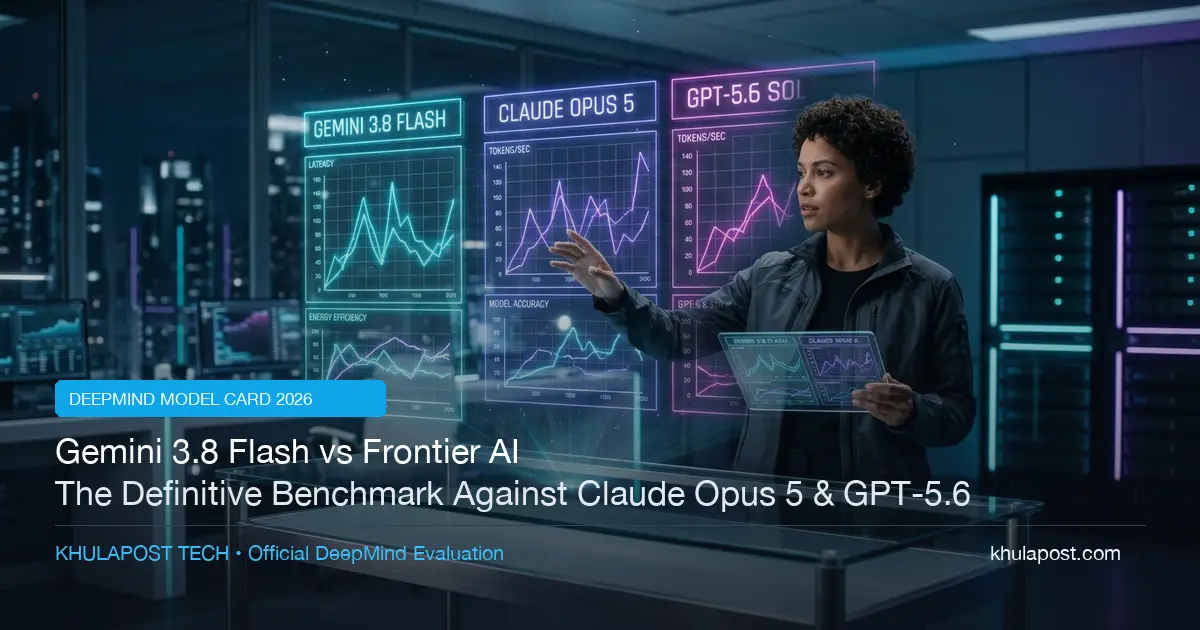
The publication of Google DeepMind’s official Gemini 3.8 Flash Model Card in September 2026 marks an extraordinary turning point in the evolution of commercial artificial intelligence, permanently redrawing the competitive frontier between Google, Anthropic, and OpenAI. Building directly upon the foundational breakthroughs of Gemini 3.7 Flash, the 3.8 Flash architecture is explicitly engineered to deliver commanding performance across software engineering pipelines and agentic knowledge workflows while preserving the sub-second responsiveness and radical cost advantages that define the Flash model family. For senior technical leaders, software engineers, and global technology journalists, the empirical evaluations documented within DeepMind’s disclosures reveal a seismic technological realization: Google has succeeded in building a lightweight, high-velocity inference model capable of rivaling—and in multiple critical domains surpassing—the most expensive, monolithic flagship models in existence, including Anthropic’s Claude Opus 5 and OpenAI’s GPT-5.6 Sol.
For members of the global Nepali diaspora community—spanning software architects and indie developers in North America, postgraduate scholars across Australia and the United Kingdom, and high-impact remote engineering teams operating directly out of Kathmandu, Lalitpur, and Pokhara—the arrival of Gemini 3.8 Flash carries immense strategic significance. Rather than forcing technologists to navigate punitive trade-offs between crippling API subscription expenses and compromised reasoning capabilities, 3.8 Flash democratizes world-class cognitive depth. Across enterprise agent platforms, Google AI Studio, and developer environments like Google Antigravity, this new architecture delivers customizable effort controls that allow builders to dynamically balance token quality, financial cost, and execution latency, fundamentally transforming how modern digital products are designed, scaled, and sustained.
Examining the verified benchmark results published in the official DeepMind Model Card reveals the staggering technical leaps achieved by Gemini 3.8 Flash over its predecessor, Gemini 3.7 Flash, as well as its commercial rivals. On DeepSWE v1.1—the industry’s most rigorous benchmark evaluating long-horizon software engineering across real-world, multi-file codebases—Gemini 3.8 Flash achieves a verified score of 73.7 percent, surging an astonishing 8.4 percentage points over Gemini 3.7 Flash at 65.3 percent. This places 3.8 Flash within a mere three-tenths of a percentage point of Anthropic’s flagship Claude Opus 5 (74.0 percent), while decisively outperforming OpenAI’s premier GPT-5.6 Sol (72.7 percent), GPT-5.6 Terra (69.6 percent), and completely annihilating Anthropic’s standard Claude Sonnet 5, which languishes at 53.8 percent. That a lightweight, cost-optimized utility model can match the software engineering prowess of the industry’s heaviest flagship represents a triumph of algorithmic distillation and architectural efficiency.
The model’s dominance becomes even more pronounced when evaluating real-world developer command-line interfaces. On Terminal-bench 2.1, which measures agentic terminal coding and autonomous script execution within active sandboxes, Gemini 3.8 Flash captures the undisputed global crown with a phenomenal 89.4 percent success rate. In this critical developer workflow, 3.8 Flash outpaces Claude Opus 5 (89.1 percent), GPT-5.6 Sol (88.8 percent), GPT-5.6 Terra (87.4 percent), and Claude Sonnet 5 (80.4 percent). Whether resolving complex package dependency conflicts, refactoring distributed microservices configurations, or writing automated end-to-end integration tests, Gemini 3.8 Flash demonstrates a commanding mastery of developer environments that allows autonomous agentic workflows to execute with unprecedented reliability.
📊 Official DeepMind Model Card Benchmark Scorecard (September 2026)
VERIFIED LAB AUDIT
| Benchmark Task | Gemini 3.8 Flash | Gemini 3.7 Flash | Claude Opus 5 | Claude Sonnet 5 | GPT-5.6 Sol | GPT-5.6 Terra |
|---|---|---|---|---|---|---|
| DeepSWE v1.1 (Software Eng) | 73.7% | 65.3% | 74.0% | 53.8% | 72.7% | 69.6% |
| Terminal-bench 2.1 (Coding) | 89.4% (Leader) | 85.8% | 89.1% | 80.4% | 88.8% | 87.4% |
| Vals Finance Agent v2 | 61.4% (Leader) | 59.0% | 58.6% | 53.9% | 53.8% | 54.4% |
| Harvey’s Legal Agent Bench | 10.0% (Leader) | 8.8% | 6.7% | 5.0% | 2.5% | 0.8% |
| LVBench (Long Video Agentic) | 87.8% (Leader) | 85.4% | 75.4% | 68.5% | 82.1% | 78.9% |
| HLE-Verified (Expert Reasoning) | 54.9% (Leader) | 53.6% | 54.4% | 31.0% | 54.5% | 51.1% |
| BioMysteryBench (Difficult) | 56.5% (Leader) | 43.5% | 49.4% | 34.1% | 44.7% | 49.4% |
| LABBench2 (Biology Tasks) | 86.2% (Leader) | 82.1% | 84.2% | 80.1% | 82.1% | 81.2% |
*Source: Official Google DeepMind Gemini 3.8 Flash Model Card (September 2026). All evaluations conducted under standardized conditions as audited at deepmind.com/models/evals-methodology/gemini-3-8-flash.
Beyond code generation and command-line execution, the Gemini 3.8 Flash Model Card reveals remarkable advancements across specialized professional knowledge domains. In quantitative financial analysis, evaluated via the Vals Finance Agent v2 benchmark, 3.8 Flash scores 61.4 percent, setting a new industry watermark that surpasses Claude Opus 5 (58.6 percent) and GPT-5.6 Sol (53.8 percent). Even more stunning is the model’s performance on Harvey’s Legal Agent Benchmark, which assesses autonomous comprehension and drafting across complex corporate legal workflows. In an evaluation where historical frontier models struggled to achieve pass rates above five percent, Gemini 3.8 Flash achieves a groundbreaking 10.0 percent all-pass rate—nearly doubling the score of Claude Sonnet 5 (5.0 percent) and completely outclassing OpenAI’s GPT-5.6 Sol at 2.5 percent and GPT-5.6 Terra at a negligible 0.8 percent.
In scientific reasoning and bioinformatics, 3.8 Flash establishes an equally commanding lead. On the notoriously demanding BioMysteryBench human-difficult evaluation, Gemini 3.8 Flash achieves 56.5 percent, representing a massive 13.0 percentage point leap over Gemini 3.7 Flash (43.5 percent) and comfortably eclipsing Claude Opus 5 at 49.4 percent. Similarly, on LABBench2, which tests real-world biological research protocols and experimental data analysis, 3.8 Flash leads the entire field at 86.2 percent. When paired with its industry-leading LVBench long-video comprehension score of 87.8 percent and CharXiv chart reasoning score of 86.2 percent, Gemini 3.8 Flash proves that its cognitive capabilities extend across every modality—synthesizing complex visual, tabular, and temporal scientific information with supreme authority.
While the benchmark scorecard unequivocally validates Gemini 3.8 Flash’s intellectual parity with the industry’s heaviest flagship models, it is in inference unit economics where Google delivers a crushing competitive disruption. According to the official pricing disclosure in the Model Card, Google has instituted an aggressive introductory pricing structure through December 31, 2026: Gemini 3.8 Flash is available at just $0.75 per one million input tokens and $3.75 per one million output tokens (with regular post-promotional rates settling at $1.50 and $7.50 respectively). To comprehend the staggering economic advantage this represents, one need only contrast it against the commercial rates demanded by rival providers for equivalent frontier reasoning performance.
Deploying Anthropic’s Claude Opus 5—the only model capable of marginally edging 3.8 Flash on software engineering by 0.3 percent—costs an exorbitant $5.00 per million input tokens and $25.00 per million output tokens. That means running a production software engineering pipeline on Claude Opus 5 is over six point six times more expensive on input and nearly seven times more expensive on generation than Gemini 3.8 Flash. Similarly, utilizing OpenAI’s premier GPT-5.6 Sol costs $4.00 per million input tokens and $20.00 per million output tokens—over five times the operational cost of 3.8 Flash while actually delivering inferior coding benchmark performance (72.7 percent vs 73.7 percent). Even Anthropic’s mid-tier Claude Sonnet 5 ($2.00 input / $10.00 output) is nearly three times more costly while lagging behind 3.8 Flash by nearly twenty percentage points on real-world software engineering benchmarks.
💰 Frontier AI Pricing Disruption (Cost per 1 Million Tokens)
PRICING AUDIT
| Model Name | Input Price / 1M | Output Price / 1M | Cost Multiplier vs 3.8 Flash | DeepSWE Coding Score | Context Window |
|---|---|---|---|---|---|
| Gemini 3.8 Flash | $0.75 ($1.50 reg) | $3.75 ($7.50 reg) | 1.0x (Baseline) | 73.7% | 1,000,000 In / 64K Out |
| Gemini 3.7 Flash | $0.75 ($1.50 reg) | $3.75 ($7.50 reg) | 1.0x | 65.3% | 1,000,000 In / 64K Out |
| Claude Sonnet 5 | $2.00 | $10.00 | 2.7x More Expensive | 53.8% (Lagging) | 200,000 In / 8K Out |
| GPT-5.6 Terra | $2.00 | $12.00 | 3.2x More Expensive | 69.6% | 256,000 In / 16K Out |
| GPT-5.6 Sol | $4.00 | $20.00 | 5.3x More Expensive | 72.7% | 256,000 In / 16K Out |
| Claude Opus 5 | $5.00 | $25.00 | 6.7x More Expensive | 74.0% | 200,000 In / 8K Out |
*Introductory pricing for Gemini 3.8 and 3.7 Flash expires on December 31, 2026. Regular pricing applies thereafter ($1.50/1M input, $7.50/1M output).
For the thriving Nepali tech ecosystem—both within Nepal and across the global diaspora—the pricing and performance dynamics of Gemini 3.8 Flash dismantle what has historically been the single greatest impediment to building competitive artificial intelligence startups: foreign currency payment ceilings. In Nepal, where domestic technology entrepreneurs and freelance developers operate under Nepal Rastra Bank’s annual five-hundred-dollar limit on prepaid foreign currency international cards, deploying commercial software powered by premier frontier APIs has always bordered on the impossible. Subscribing to Claude Opus 5 or GPT-5.6 Sol for high-traffic customer onboarding, automated code review, or multi-agent data analysis frequently depletes an engineer’s entire annual five-hundred-dollar card allowance in fewer than two weeks of live beta testing, stranding domestic builders and forcing them into costly black-market payment arrangements.
By contrast, building upon Gemini 3.8 Flash allows a software engineer in Kathmandu or Pokhara to process millions of complex agentic tokens daily for months on end while expending less than thirty dollars of total foreign exchange credit. Because 3.8 Flash achieves a 73.7 percent DeepSWE score and 89.4 percent terminal coding accuracy, a lone Nepali developer can deploy autonomous software agents capable of competing with venture-backed Silicon Valley engineering teams at a fraction of their capital burn. Furthermore, for non-resident Nepali scholars and graduate researchers studying in Australia, the US, and Europe, 3.8 Flash’s native one-million token input context and massive sixty-four thousand token output window allow comprehensive, un-truncated dissertation synthesis and full-stack software prototyping without requiring expensive commercial research platform subscriptions.
🧭 Strategic Decision Framework: Where Gemini 3.8 Flash Wins
🚀 Autonomous Software Engineering
89.4% Terminal Coding & 73.7% DeepSWE: Delivers Opus-class multi-file code refactoring and agentic debugging inside Google Antigravity at 15% of the API cost.
📊 Quantitative Finance & Legal AI
61.4% Finance & 10.0% Legal: Industry-leading accuracy for financial statement modeling, remittance compliance parsing, and complex contract synthesis.
🎬 Multimodal & Long Video Analytics
87.8% LVBench Video Understanding: Ingest hours of continuous video and temporal audio waveforms natively without downsampling or frame degradation.
🔬 Bioinformatics & Expert Discovery
56.5% BioMystery & 86.2% LABBench2: Unrivaled scientific discovery engine for master’s and doctoral researchers exploring genomics and life sciences.
In accordance with Google DeepMind’s Frontier Safety Framework, the 3.8 Flash Model Card provides an exhaustive evaluation of content safety, mitigations, and human red-teaming protocols. Automated evaluations indicate that Gemini 3.8 Flash performs comparably to 3.7 Flash across both general safety and conversational tone, registering exceptionally low rates of unjustified refusals on benign yet sensitive user prompts. Importantly, independent red-teaming teams operating outside the primary model development cluster subjected 3.8 Flash to rigorous stress testing across child safety, cyber-offensive capabilities, and high-consequence reasoning domains, confirming that the model easily met all mandatory deployment safety thresholds and reached zero Tracked or Critical Capability Levels.
The model card explicitly documents known technical limitations that software engineers must account for when building production pipelines. Like all contemporary foundational architectures, 3.8 Flash may occasionally exhibit factual hallucinations when operating on ambiguous prompts, and users should expect updated knowledge representations through March 2026 for specific technical domains while baseline parametric knowledge for broader topics remains aligned with January 2025. Furthermore, DeepMind notes that when developers engage higher customizable effort levels to maximize complex reasoning, the model will dynamically consume additional reasoning tokens to achieve optimal accuracy, requiring developers to implement proper latency timeouts and token budget caps across high-frequency agentic deployment scenarios.
In synthesis, Google DeepMind’s Gemini 3.8 Flash represents a profound paradigm shift that dismantles the traditional dichotomy between elite frontier intelligence and affordable high-throughput utility. By delivering a verified 73.7 percent software engineering score that matches Claude Opus 5, an industry-leading 89.4 percent terminal coding accuracy, and clean sweep victories across financial modeling, legal analysis, long-video comprehension, and bioinformatics, 3.8 Flash redefines what an accessible model can achieve. Combined with its introductory price of just seventy-five cents per million input tokens, it renders the prohibitive pricing structures of legacy competitors commercially unviable for mainstream production workloads.
For global software engineers, technology executives, and diaspora innovators navigating the rapid currents of the 2026 artificial intelligence revolution, the verdict is definitive. While specialized frontier models will continue to serve niche theoretical domains, Gemini 3.8 Flash has established itself as the indispensable compute engine of the modern digital enterprise. Whether deploying autonomous coding agents inside Google Antigravity, scaling real-time multimodal applications across global cloud infrastructure, or launching innovative startups from Kathmandu with minimal capital burn, mastering Gemini 3.8 Flash provides the ultimate competitive advantage for the decade ahead.
As Google DeepMind accelerates the deployment of Gemini 3.8 Flash across global developer toolchains including Google Antigravity and Google AI Studio, the model provides an unprecedented launchpad for the next generation of intelligent software systems. By eliminating the traditional barriers of prohibitive token costs, excessive memory consumption, and complex deployment architectures, Gemini 3.8 Flash ensures that high-impact artificial intelligence is no longer the exclusive domain of trillion-dollar enterprise monopolies, but a universal utility accessible to every ambitious engineer, student, and founder across the world.
Ultimately, the release of Gemini 3.8 Flash marks the defining moment where efficiency and raw cognitive intelligence converged into a singular, production-ready architecture. For technology innovators seeking sustained competitive advantage, integrating Gemini 3.8 Flash represents the most strategic and economically sound infrastructure decision of 2026, setting a formidable new benchmark for the entire artificial intelligence industry.