

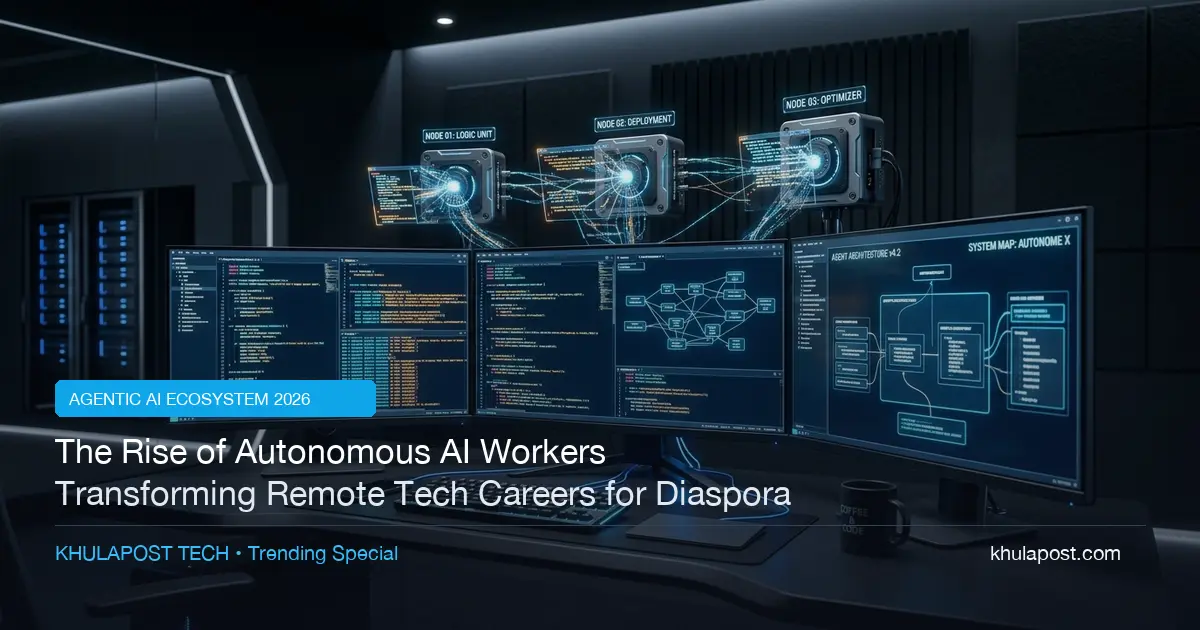
The artificial intelligence narrative in 2026 has decisively transitioned from conversational chatbots to autonomous agentic architectures—systems capable of decomposing complex business goals into independent sub-tasks, reasoning through ambiguous logic, executing multi-step software code, and self-correcting errors without human intervention. For remote software engineers, full-stack developers, and technical project managers within the global Nepali diaspora, this evolution represents both a monumental productivity multiplier and a fundamental shift in career expectations. Rather than writing boilerplate syntax manually, contemporary tech workers are evolving into orchestrators of autonomous agent teams, delegating routine unit testing, continuous integration debugging, and cloud infrastructure deployment to specialized artificial intelligence agents.
Technologically, agentic AI frameworks operate through iterative reflection loops, utilizing long-context reasoning models to interact directly with command-line terminals, web browsers, and external APIs. Leading platforms such as Claude Code, AutoGen Studio, and Devin-class autonomous environments can ingest entire legacy code repositories, identify security vulnerabilities, write comprehensive regression test suites, and submit complete pull requests in minutes. This shift democratizes high-velocity software engineering, enabling a single remote developer operating out of Kathmandu, Sydney, or Dallas to maintain complex microservices architectures that previously required ten-person engineering departments.
🤖 2026 Autonomous Agentic AI Frameworks Benchmark
AGENT MATURITY MATRIX
| Agentic Framework | Core Autonomy Focus | SWE-Bench Score | Cost / Task | Freelancer Utility |
|---|---|---|---|---|
| Claude Code / Anthropic | Terminal & Git Automation | 68.4% Verified | $0.40 – $1.20 | Full-Stack Refactoring |
| Cursor Composer Agent | IDE Context Multi-File Edits | 62.1% Verified | Included in $20/mo | Rapid Feature Prototyping |
| OpenHands / SWE-Agent | Open-Source Sandbox Execution | 54.8% Verified | Free Local / API Cost | Custom Enterprise Workflows |
| Google Vertex Agentic | Enterprise Cloud Integration | 65.2% Verified | Pay-per-Token Tier | Data Analytics & DevOps |
For Nepali tech workers operating in international remote contracting roles, mastering agentic AI tooling is becoming the primary differentiator for securing high-compensation Western freelance contracts. While junior developers who limit themselves to manual syntax writing face intense pricing pressure, engineers who leverage autonomous multi-agent pipelines to deliver production-ready software features five times faster can command premium hourly rates of fifty to one hundred dollars. Moreover, managing API token expenses through smart routing and leveraging open-weight models hosted on affordable cloud instances prevents local developers from exhausting their annual foreign currency card limits.
To conclude, the rise of agentic artificial intelligence represents not the elimination of software engineers, but their elevation to systems architects and product directors. Diaspora technologists who proactively incorporate autonomous agents into their daily development lifecycle will lead the next generation of global software innovation from anywhere in the world.